Hypertrophy Explained: How to Build Muscle Without Overcomplicating It

5/29/2026

6 min

If you’ve spent any time in a gym or on fitness social media, you’ve probably heard the word hypertrophy. It’s often thrown around alongside complicated workout programs, advanced techniques, and conflicting advice about the “best” way to build muscle.


For beginners, that can make muscle growth seem far more complicated than it actually is.


The truth is that hypertrophy—the scientific term for muscle growth—is driven by a handful of proven principles. You don’t need a perfect program, fancy equipment, or a degree in exercise science to build muscle. You simply need to understand the fundamentals and apply them consistently.

Quick Answer

Hypertrophy is the process of increasing muscle size through resistance training.

To maximize muscle growth, focus on:
Consistent strength training
Progressive overload
Sufficient training volume
Adequate protein intake
Quality recovery and sleep
Long-term consistency

Most people get better results from mastering these basics than from chasing advanced training methods.

What Is Hypertrophy?

Hypertrophy simply refers to an increase in muscle size. When you challenge your muscles through resistance training, your body adapts by repairing and strengthening muscle tissue so it can better handle similar demands in the future (Schoenfeld, 2010).


A common misconception is that muscles grow during a workout. In reality, training provides the stimulus, but growth occurs afterward during recovery.


Think of your workout as sending your body a message:

“This muscle needs to be stronger for next time.”

Your body responds by rebuilding the muscle slightly larger and stronger.

The Biggest Drivers of Muscle Growth

While many factors influence hypertrophy, three stand out as the most important.


Mechanical Tension


Mechanical tension occurs when muscles produce produce force against resistance. In simple terms, this means lifting weights that are challenging enough to require significant effort.


This doesn’t mean every set needs to be a maximal effort, but the weight should be heavy enough that the muscles are working hard.


Training Volume


Training volume refers to the amount of work you perform, typically measured through sets and repetitions.


Many beginners assume more volume automatically equals more muscle growth. While volume is important, there are diminishing returns. Research suggests that a moderate amount of quality training is often enough to produce significant results, especially for beginners (Schoenfeld et al., 2017).


Effort


To stimulate muscle growth, your sets should be reasonably challenging. Most evidence suggests that training relatively close to muscular failure can effectively promote hypertrophy (Grgic et al., 2022).


Fortunately, you don’t need to completely exhaust yourself every workout. Leaving one to three repetitions “in the tank” is often a practical and sustainable approach.

Progressive Overload Still Matters

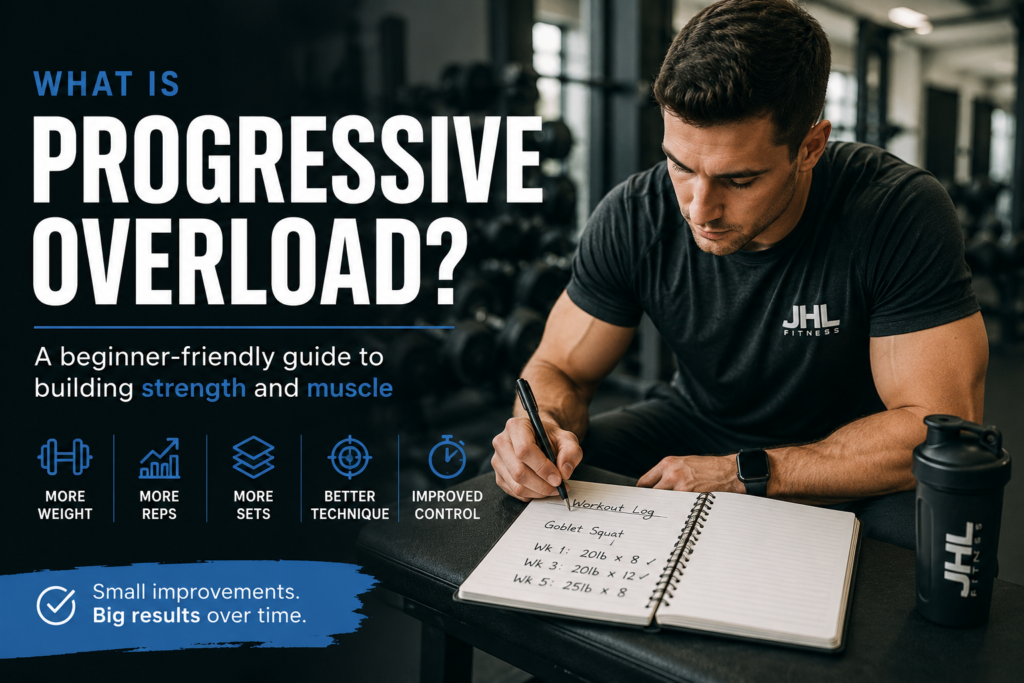
One of the most important concepts in muscle building is progressive overload.


As your body adapts to training, the same workout becomes easier. If you want to continue building muscle, you must gradually increase the challenge over time.


This can be accomplished by:

Increasing weight

Performing more repetitions

Adding additional sets

Improving exercise technique

Increasing range of motion


Progressive overload doesn’t mean adding weight every workout forever. Progress often occurs gradually, and small improvements can add up to significant results over months and years.

Nutrition and Recovery Are Part of the Process

Training provides the stimulus for muscle growth, but nutrition and recovery provide the resources.


Protein is particularly important because it supplies the amino acids needed for muscle repair and growth. For most people looking to build muscle, consuming approximately 1.4–2.2 grams of protein per kilogram of body weight per day is an effective target (Morton et al., 2018). Learn more about your daily protein intake needs


Sleep is equally important. Recovery is when your body adapts to training, making seven to nine hours of quality sleep per night a worthwhile investment in your progress.


Many people focus entirely on workouts while neglecting recovery. In reality, both are essential pieces of the same puzzle.

Common Hypertrophy Mistakes

Many beginners unknowingly make muscle growth harder than it needs to be.


The most common mistakes include:

Constantly changing workout programs

Chasing soreness as a measure of success

Performing excessive amounts of training volume

Neglecting recovery and sleep

Expecting dramatic results within a few weeks


Building muscle is a slow process. While beginners often see encouraging progress early on, meaningful muscle growth typically occurs over months and years—not days and weeks.

Practical Takeaway:

If your goal is to build muscle, focus on the fundamentals:
Train consistently two to five times per week
Prioritize progressive overload
Eat enough protein
Recover well between sessions
Stay patient and consistent

The fitness industry often promotes shortcuts and hacks, but most successful muscle-building journeys are built on simple habits performed consistently.

You don't need a perfect plan. You need a plan you can stick with.

If you're feeling overwhelmed by conflicting advice online, remember that mastering the basics will take you much further than constantly searching for the next secret technique.
Need help applying these principles to your own schedule, goals, and lifestyle? JHL Fitness focuses on practical, evidence-based coaching designed to help busy people build strength, muscle, and sustainable habits without overcomplicating the process.


Need help applying this to your lifestyle?

Citations