
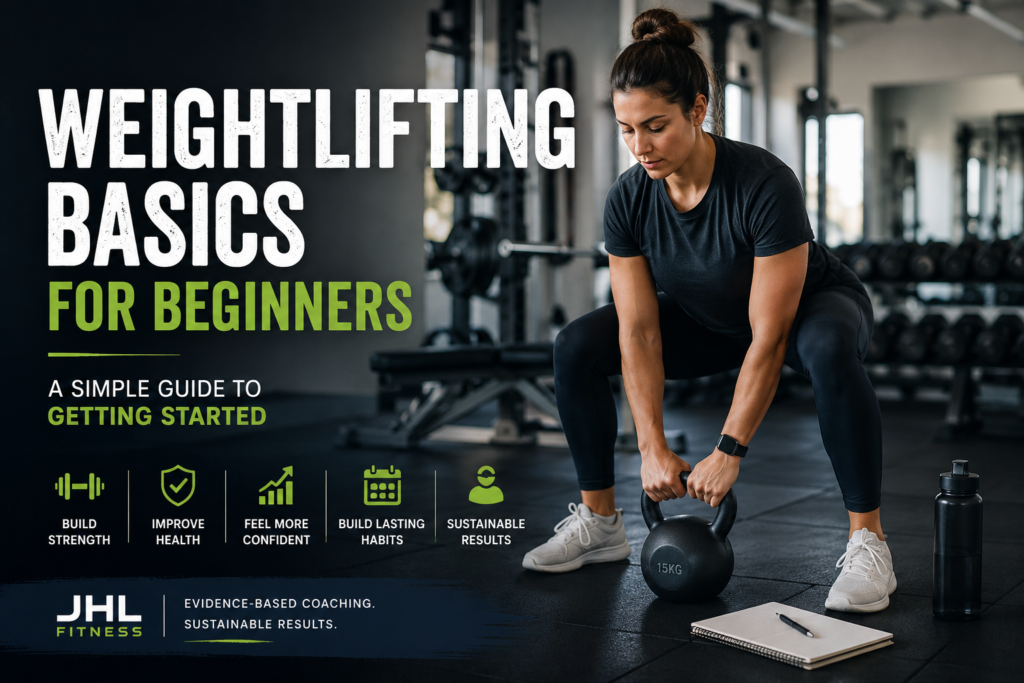
Starting the gym can feel overwhelming. Between complicated workout programs, conflicting fitness advice online, and people throwing around terms like “Hypertrophy,” “RPE,” and “Volume,” it’s easy to feel like you need a degree in exercise science just to begin.
The truth? Most beginners don’t need complicated plans to make great progress.
In fact, beginners often see the best results from focusing on a few simple fundamentals: consistency, basic movement patterns, reasonable nutrition, and patience.
You do not need to train like a bodybuilder, spend two hours in the gym, or completely overhaul your life overnight.
This guide will break down the basics of exercise and weightlifting in a simple, practical way so you can start building strength and confidence without feeling overwhelmed.
If you’re new to lifting weights, focus on these basics:
Train consistently 2–4 days per week
Learn foundational movement patterns
Prioritize good form over heavy weight
Stick with simple exercises for several months
Sleep, recovery, and nutrition matter too
Progress comes from consistency, not perfection
You do not need the “perfect” program to get started. You just need a sustainable plan you can stick to.
Strength training is one of the most beneficial things you can do for your health. While many people start exercising to improve appearance or lose weight, resistance training also helps improve strength, posture, energy levels, bone density, and long-term health (Westcott, 2012).
When you lift weights, your body adapts to the stress over time by building stronger muscles and connective tissue. This process happens gradually, which is why consistency matters far more than intensity early on.
One of the biggest misconceptions beginners have is that they need to train extremely hard right away. In reality, beginners often make excellent progress with moderate effort because their bodies are adapting quickly to a completely new stimulus.
Another common fear is becoming “too bulky.” Building large amounts of muscle takes years of intentional training, nutrition, and consistency. Most beginners will simply notice improved strength, muscle tone, posture, and confidence.
Weightlifting also works well alongside cardio. You do not have to choose one or the other. Walking, cycling, running, or other forms of cardio can complement strength training and improve overall health.
A lot of beginners get stuck trying to find the “best” exercises. Instead of worrying about fancy movements, focus on learning a few foundational movement patterns first.
Most beginner workouts can be built around these five categories:
| Movement Pattern | Beginner Exercise Examples |
|---|---|
| Push | Push-ups, dumbbell bench press |
| Pull | Lat pulldown, dumbbell row |
| Squat | Goblet squat, leg press |
| Hinge | Romanian deadlift, hip hinge |
| Core/Stability | Planks, dead bugs |
These movements train the major muscle groups while teaching coordination, stability, and body awareness.
The good news is you do not need dozens of exercises. Many beginners make the mistake of constantly changing workouts because they think variety equals progress. In reality, repeating basic exercises consistently is usually more effective because it allows you to improve technique and gradually increase strength over time.
Think of exercise like learning a skill. Repetition matters.
One of the biggest sources of confusion for beginners is Workout Structure. Thankfully, beginner programs do not need to be complicated.
Most beginners do well with:
A simple workout might include:
For example:
That’s it.
You do not need marathon workouts or advanced training techniques. The goal early on is to build consistency, improve movement quality, and slowly get stronger.
It’s also important to avoid the “all or nothing” mindset. Beginners often try to train six days per week immediately, only to burn out after a few weeks. Starting smaller and building sustainable habits is usually more effective long term.
Another important concept is progressive overload, which simply means gradually increasing the challenge over time. This could mean:
Progress does not need to happen every workout. Small improvements add up over months and years.
Protein
Many people focus entirely on workouts while ignoring recovery. But your body actually adapts and grows outside the gym.
Sleep, nutrition, hydration, and stress management all play major roles in recovery and performance (Kellmann, 2010).
The good news is beginners do not need perfect recovery habits to make progress. You do not need expensive supplements or an extremely strict diet. Instead, focus on the basics:
Protein is especially important because it supports muscle repair and growth. Research suggests that active individuals benefit from higher protein intakes than sedentary individuals, especially during resistance training (Morton et al., 2018).
This is also where sustainable nutrition matters. You do not need to eliminate entire food groups or follow extreme diets. Building balanced habits you can maintain long term is far more important than chasing perfection for two weeks.
If there’s one thing most successful fitness journeys have in common, it’s consistency.
Not motivation.
Not supplements.
Not the perfect workout split.
Consistency.
There will be weeks where life gets busy. You’ll miss workouts sometimes. Your motivation will fluctuate. That’s normal.
The people who make long-term progress are usually the ones who learn how to keep going imperfectly instead of quitting entirely.
Fitness is not about being perfect every day. It’s about building habits that fit realistically into your life.
The best workout program is the one you can consistently follow.
The best nutrition plan is the one you can realistically maintain.
And the best approach to fitness is usually the one that reduces overwhelm instead of adding more stress to your life.
Protein
If you’re just starting your fitness journey, focus on these five things:
Train consistently 2–4 times per week
Learn basic movement patterns
Prioritize form over heavy weights
Sleep and eat reasonably well
Be patient with progress
You do not need to master everything immediately. Start simple, stay consistent, and allow yourself time to improve.
Online Coaching | Science Based Fitness and Nutrition