
If you’ve spent any time researching fitness online, you’ve probably heard the term “progressive overload.” It’s often treated like some complicated training secret, but the concept is actually pretty simple.
Progressive overload just means gradually increasing the demands placed on your body over time so it continues adapting. In practical terms, that’s how you build muscle, gain strength, and improve fitness long term (American College of Sports Medicine [ACSM], 2009).
The important thing to understand is that progress does not need to be extreme to be effective. You don’t need to destroy yourself in every workout or add 20 pounds to the bar every week. Small, sustainable improvements matter far more than dramatic jumps.
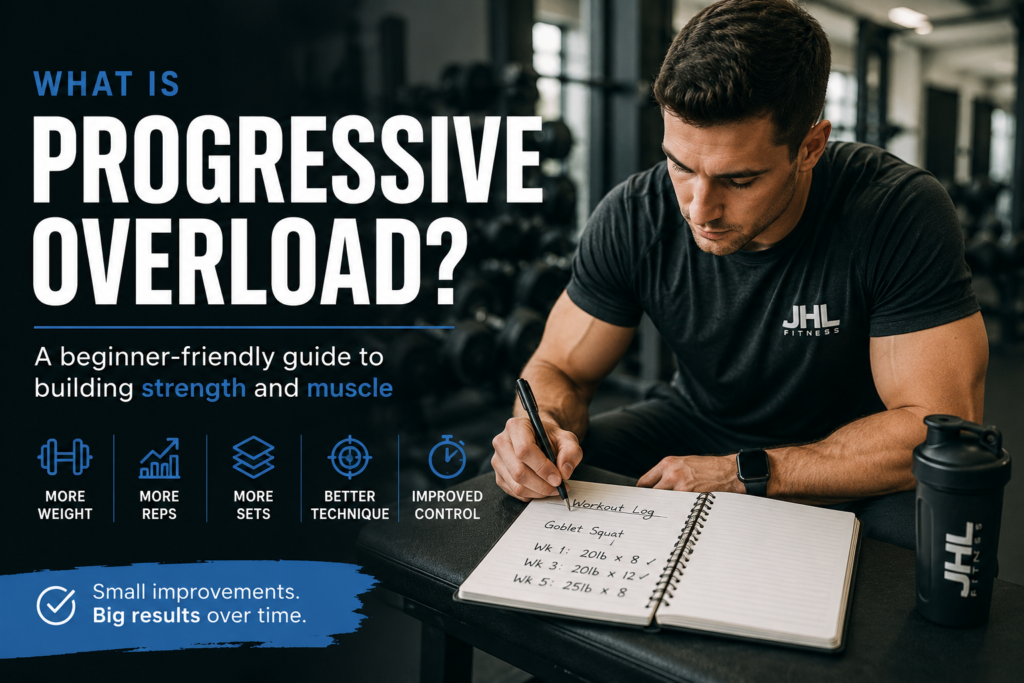
Progressive overload = gradually increasing training demand over time Progress can come from: more weight more reps better technique improved control additional sets Progress should feel sustainable, not reckless Small improvements repeated consistently lead to long-term results
A lot of beginners assume progressive overload only means lifting heavier weights. While adding weight is one method, it’s far from the only one.
For example:
Week 1: Goblet squat — 20 lbs for 8 reps
Week 3: Goblet squat — 20 lbs for 12 reps
Week 5: Goblet squat — 25 lbs for 8 reps
All three represent progress.
You can also apply progressive overload by:
improving exercise technique
increasing control during reps
adding another set
shortening rest periods slightly
improving range of motion
Research on muscle hypertrophy consistently shows that progressive increases in training stimulus are one of the key drivers of muscle growth and strength development (Schoenfeld, 2010).
One of the most common mistakes beginners make is trying to progress too quickly.
Adding weight before mastering technique often leads to:
poor movement quality
stalled progress
increased injury risk
Another mistake is constantly changing workouts. If you switch exercises every week, it becomes difficult to measure progress accurately. Consistency allows your body enough time to adapt.
It’s also important to remember that soreness is not the same thing as progress. You do not need to feel destroyed after every workout to build muscle or get stronger.
Fitness progress is usually slower and less dramatic than social media makes it seem. That’s normal.
Protein
The best approach for most beginners is simple:
Pick a structured workout routine
Track your exercises, sets, and reps
Focus on small improvements over time
Prioritize good technique
Stay patient and consistent
Even adding one extra rep with good form is progress.
Research also shows that beginners often respond very well to consistent resistance training because their bodies adapt quickly during the early stages of training (ACSM, 2009). That means you do not need a perfect program to start seeing results.
Progressive overload is not about constantly pushing harder at all costs. It’s about giving your body a reason to adapt while still recovering properly. Fitness results are usually built through small wins repeated consistently over months and years. If you can gradually do a little more over time while maintaining good form and recovering well, you’re probably moving in the right direction. Need help building a workout plan that progresses realistically with your schedule and goals? JHL Fitness coaching is designed to simplify the process and help you build sustainable habits without the overwhelm.
Online Coaching | Science Based Fitness and Nutrition