
If you’re new to fitness, one of the biggest questions is usually: How often should I actually work out?
Social media often makes it seem like you need to train six or seven days a week to see results. But for most beginners, that approach usually leads to burnout, soreness, or inconsistency rather than long-term progress.
The truth is that most beginners can make excellent progress with just 2-4 workouts per week. The best workout schedule is not the most intense one — it’s the one you can realistically stick to.
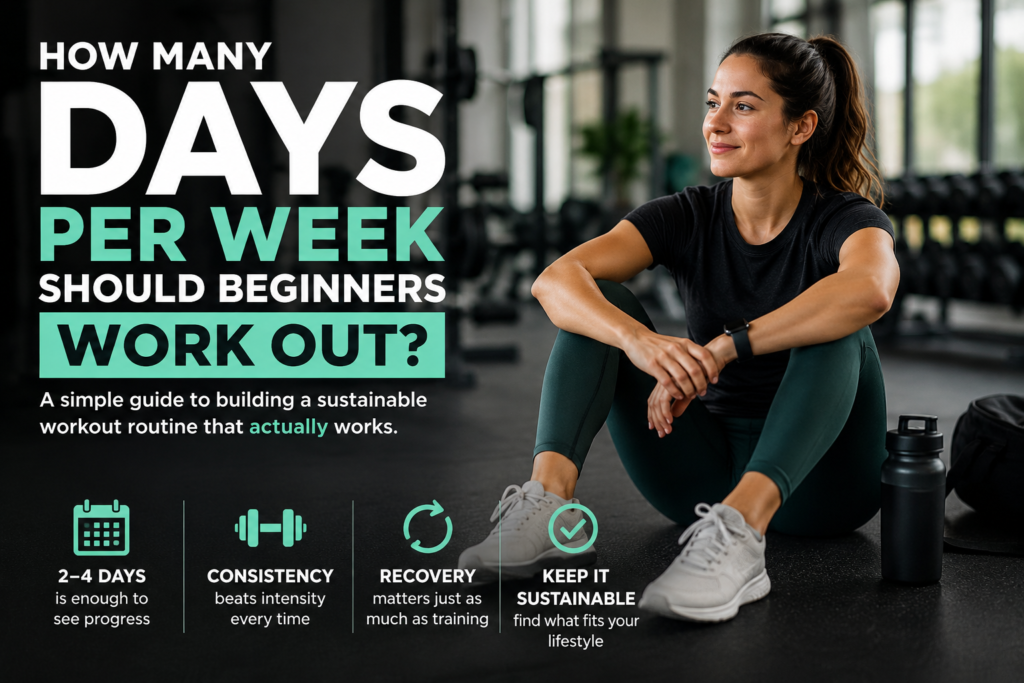
For most beginners: 2–4 workouts per week is enough to see progress Full-body workouts are usually the best starting point Recovery matters just as much as training consistency beats perfection every time
When you first start working out, your body needs time to adapt. Your muscles, joints, nervous system, and recovery capacity are all adjusting to new stress. That means training harder or more frequently isn’t always better.
Research shows beginners can build strength and muscle effectively with moderate training volume, especially when workouts are consistent over time (American College of Sports Medicine [ACSM], 2009).
One of the biggest mistakes beginners make is trying to copy advanced lifters or fitness influencers. Someone who has been training for 10 years can usually tolerate more volume and frequency than someone who started last month.
Instead of asking:
“What’s the maximum I can do?”
Beginners should ask:
“What can I realistically recover from and maintain consistently?”
2 Days per Week
Great for:
busy schedules
complete beginners
rebuilding exercise habits
Two days per week is enough to improve strength, energy levels, and overall fitness when done consistently.
3 Days per Week
This is often the sweet spot for beginners.
Three weekly workouts provide enough training stimulus while still allowing plenty of recovery time. Full-body workouts work especially well here.
4 Days per Week
Four days can work well if:
you enjoy training
your schedule allows it
recovery is good
At this point, many people transition into upper/lower splits or slightly more structured programming.
Beginners often overthink workout splits, exercise selection, or “optimal” training frequency.
In reality, the fundamentals matter far more:
consistency
sleep
nutrition
progressive overload
good exercise technique
Someone training three days per week consistently for a year will almost always outperform someone who trains six days per week for one month before quitting. That’s why sustainable fitness habits matter so much. Progress is built through repetition over time — not extreme short-term motivation.
If you’re a beginner, you probably don’t need to work out every day to see results. Starting with 2–4 workouts per week is usually more than enough to build strength, improve health, and create long-term habits. Start Simple . Focus on consistency. Build momentum first. The best workout plan is the one you can still follow six months from now. Need help building a workout routine around your actual schedule and goals? JHL Fitness focuses on practical, sustainable coaching designed for busy people who want realistic results without overcomplicating fitness.
Online Coaching | Science Based Fitness and Nutrition